
The compact segment where Sonet will be launched is crowded with the Maruti Vitara and Brezza, which top the sales' list, and a bevy of models from Mahindra & Mahindra apart from Hyundai's offering. But volumes in this are slightly higher than those in the mid-segment, making it attractive, says Surajeet Das Gupta.

In his Marathi autobiography Lok Maze Saangati published in 2015, Pawar has lavished praise on Adani describing him as 'hard-working, simple, down to earth' and with ambition to make big in the infrastructure sector.

Maruti Suzuki is set to launch a new multi-purpose vehicle (MPV) -- Invicto -- next month. It will be the company's first passenger vehicle with an ex-showroom price tag of Rs 20 lakh or more, said Shashank Srivastava, executive director (sales), on Tuesday. The upcoming MPV will compete with the likes of Toyota Innova Hycross, Kia Carnival, Hyundai Alcazar, MG Hector Plus, Tata Safari, Mahindra & Mahindra XUV700, and Mahindra & Mahindra Scorpio-N - all having three rows of seats. Invicto will be based on the Hycross by Toyota, which will manufacture Maruti's most expensive car at its Bidadi plant in Karnataka.

India's electric mobility goal, which has so far been riding on two wheels, is all set to graduate to four wheels. At least, the journey has begun. Hyundai Motor India said it would invest Rs 4,000 crore till 2028 to launch half-a-dozen electric vehicles (EVs) in India. It would eventually straddle premium and mass segments. The first of these - the electrified version of an internal combustion engine (ICE)-powered model - will go on sale as early as next year.
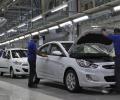
Automakers Maruti Suzuki, Tata Motors, Mahindra & Mahindra and Kia reported robust growth in their vehicle dispatches in the domestic market for August buoyed by festive demand and easing of semiconductor shortage woes. Other manufacturers like Hyundai, Toyota and Skoda also reported growth in wholesales in August as compared with the same month last year. The country's largest automaker Maruti Suzuki India said its domestic passenger vehicle dispatches increased by 30 per cent to 134,166 units in August as compared with 103,187 units in the year-ago month.

Offering buyers a car that meets their aspirations & lifestyle needs, the Creta became a style icon. The Creta, which was officially launched on Monday, is a global model, created with an investment of more than Rs 1,000 crore.
The company, whose arm Maruti Suzuki is the largest passenger vehicles maker in India, asserted that it does not align with any political or religious inclination in any part of the world.
Leading carmakers Maruti Suzuki, Hyundai and Tata Motors reported robust dispatches to dealers in May on the back of strong demand for passenger vehicles across regions, even as the global semiconductor shortage continued to impact production. Mahindra & Mahindra, Kia India, Toyota Kirloskar Motor, Honda Cars and Skoda also witnessed strong demand for their models last month. The month of May also witnessed Tata Motors race ahead of Hyundai in terms of domestic wholesales.

Both are finding it difficult to sell one each of their plants -- Chennai Maraimalai Nagar (Ford) and Talegaon near Pune (GM) -- and are finding the road blocked by employee severance snarl-ups, report Sohini Das and Shine Jacob.
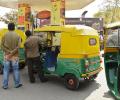
Amid a shift in mobility trends and people increasingly opting for less polluting energy sources, sales of compressed natural gas (CNG) vehicles increased more than 82 per cent in the past five years. A total of 729,902 CNG vehicles were sold in 2022-23 against 400,825 in 2017-18, according to VAHAN Dashboard. Though the increase in sales of CNG-powered vehicles has been significant, their share in overall vehicle sales remains minuscule as is the case with EVs.

Maruti Suzuki India (MSIL) - the market leader in small cars - is eyeing the top spot in the sports utility vehicle (SUV) segment within a year - with a 33 per cent share of the pie. The company has been selling two SUVs - the Brezza and the Grand Vitara - and will start deliveries of the Jimny and the Fronx from March-end, and has set a target of growing its share from the current 11.5 per cent of the SUV market to 33 per cent by the end of 2023-24. The SUV segment is roughly about 42 per cent of the total passenger vehicle market, or around 1.3 million units.

Auto experts from CarJasoos will answer all your questions related to buying, selling or maintenance of new or used cars.
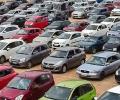
Automobile retail sales in India rose 11 per cent in September as better supplies from manufacturers enabled dealers to ramp up customer deliveries amid the ongoing festive period, Federation Of Automobile Dealers Associations said on Tuesday. Last month, total retail sales stood at 14,64,001 units as compared to 13,19,647 units in September 2021. FADA noted that October is expected to witness even better overall sales due to the festive season further gathering steam.
Carmakers Mercedes-Benz, Audi, Renault, Kia India and MG Motor on Wednesday announced plans to hike vehicle prices from January to partially offset the impact of rising input costs. They join the likes of market leader Maruti Suzuki India and Tata Motors, which have also made the year-end announcements to raise prices from next month. Audi India said it will increase prices of its entire model range by up to 1.7 per cent, while Mercedes-Benz India noted it will hike the prices by up to 5 per cent from January 1.
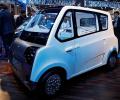
The EV industry is at an inflection point and batteries will play a critical role ahead -- batteries and related components typically constitute 35-45 per cent of an EV's costs.

A 25-year-old man from Telangana, who was found injured inside a Sports Utility Vehicle after sustaining an apparent gunshot wound to his head, has died, according to authorities in the US state of Maryland.

Even as India's passenger-vehicle sales touched a record high of 3.9 million units in 2022-23, growing 27 per cent over the previous financial year, the country's largest carmaker, Maruti Suzuki India (MSIL), said on Monday uncertainties in the electronic-component supplies might affect production in FY24. MSIL said the shortage of electronic components had some impact on production in FY23. "The company took all possible measures to minimise the impact.

Innovation ranging from exterior designs of vehicles to EV charger locks grabbed eyeballs at the expo

The Virtus is indeed designed to look, act and behave like a well-built European sedan that swims in the segment between the compact sedan VW Vento and the larger Passat, says Pavan Lall.
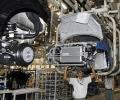
Hyundai Motor and Toyota Kirloskar Motor have announced the suspension of manufacturing operations at their respective plants amid coronavirus outbreak. On Sunday, various automakers like Maruti Suzuki India, Honda Cars, Mahindra & Mahindra and Fiat announced a temporary halt in manufacturing operations at their respective facilities.

India must integrate more with East Asia by getting into regional trade arrangements, lower its tariff walls, and improve the quality of its workforce, suggests T N Ninan.

The traffic tells a story. During the lockdown, it took 45 minutes to zip through the deserted 35-km stretch from Chennai to reach the automobile heart of Sriperumbudur-Oragadam, where the big names of the car industry - Hyundai Motor India, Renault-Nissan India, Daimler India Commercial Vehicles, Apollo Tyres, and Royal Enfield - are based.

Auto Expo 2023 may not trigger a fresh rally in automobile stocks, say analysts, as this year's edition lacks participation from major listed players. It is also owing to the focus on electric vehicles (EVs), a segment where four-wheelers have minuscule market share. "In the passenger vehicles (PV) segment, Maruti Suzuki India and Tata Motors are the only listed players.

With entry-level cars being preferred amid the pandemic, market leader Maruti Suzuki has strengthened its hold, along with Hyundai Motor India.

Close to 50 models were launched in India in the past 12 months, but companies have not been able to realise their potential due to the pandemic.

India is sceptical that Tesla might import into the country cars made in China. Tesla executives were in India last month and appear to have proposed a factory in the country. But do not be surprised if that does not happen in a hurry.

'While we have done a few thousand kilometres in India, most of the testing and data collection and analysis has been done in the US, Japan and Europe.'

The edge that Maruti Suzuki enjoys over Hyundai and other rivals stem primarily from its gigantic scale, reports Ajay Modi.
Passenger vehicle dispatches from factories to dealers in India fell 8 per cent in January, mainly due to semiconductor shortage, auto industry body SIAM said on Friday. The total passenger vehicle wholesales dropped to 254,287 units in January 2022 as compared to 276,554 units in the same month of last year. Last month, passenger car dispatches stood at 126,693 units as compared to 153,244 units in the year-ago period. Similarly, van dispatches declined to 10,632 units in the period under review from 11,816 units in January 2021.

The person arrested is the owner of the car that is said to have been used by the accused for the crime.

Officials were surprised at how quickly smugglers appraised the Covid situation to recruit jobless migrant workers to ship gold.

To ramp up domestic battery manufacturing capacity and reduce the dependence on imports, the government has initiated talks with a few lithium-rich countries to supply the mineral to Indian companies, industry sources informed Business Standard. The Ministry of External Affairs (MEA) held a meeting with the ambassadors of countries, including Argentina, Chile, and Bolivia, among others, to put forth its request.
The country's leading automakers Maruti Suzuki and Hyundai Motor reported a decline in dispatches to dealers in March as shortage of electronic components impacted production. On the other hand, Tata Motors, Skoda and Kia India posted their highest ever monthly wholesales last month. Toyota Kirloskar Motor said its dispatches in March were the highest in the last five years while Mahindra & Mahindra also reported a robust increase in its passenger vehicle dispatches in March.

'If it is your second car (electric vehicle), you typically keep it for travel within the city.' 'And the first car (internal combustion engine-run vehicles) can then be used to travel to some other cities.'
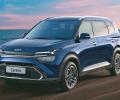
High ground clearance, a wide cabin and tall stance all mean that the Carens glides over bad roads with ease and comfort and an engine performance that is adequate in terms of the power of this vehicle, says Pavan Lall.

K-League season started on Friday with a match between Jeonbuk Hyundai Motors and Suwon Samsung Bluewings played without spectators
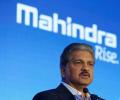
With increased consumer awareness and government support in place, it is the opportune time to enter the electric passenger vehicle segment, Mahindra Group Chairman Anand Mahindra said on Monday. With an eye on gaining leadership in the electric four-wheeler segment, the Indian auto major announced that it will launch five new electric Sports Utility Vehicles (SUVs) for both domestic and international markets, with the first four expected to hit the road between 2024 and 2026. The company would introduce the first of the five e-SUVs towards the end of 2024, starting with the Indian market.
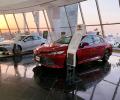
The growth momentum that started during the festival season is likely to sustain in the new year, reports Arindam Majumder.

Ahead of the peak festive season, India's passenger vehicle makers are staring at a cumulative order backlog of nearly 500,000 units as chip shortage continues to cripple production. The crisis is forcing companies to change their production plans frequently and take a call on the variants they can manufacture based on the availability of semiconductors. The booking numbers are not a true reflection of demand, said manufacturers.

The list clearly shows the dominance of Maruti and Hyundai in the Indian passenger vehicle market.
